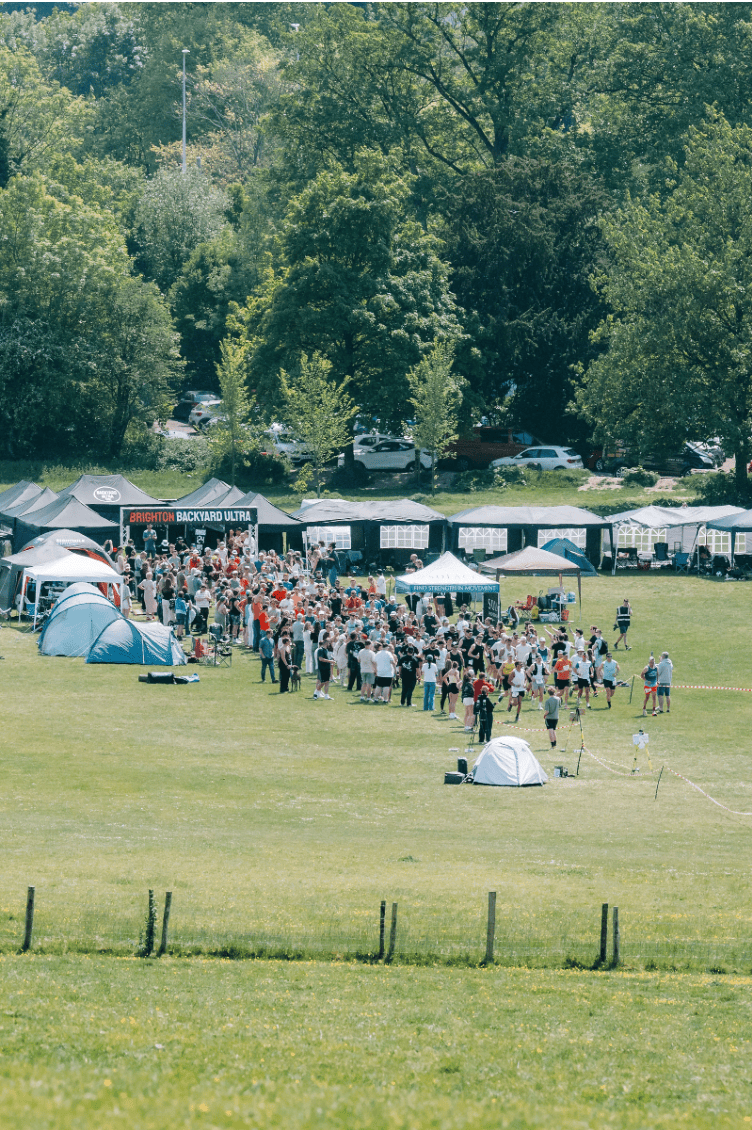
You’re almost 300 miles into your race; you’re shoving another burrito into your mouth, sloshed down with a gulp of Red Bull, and you look at your watch. Just a few more minutes until you need to start running again. How long until you finish? Well, that’s undetermined.
This is a backyard ultra. A fixed-loop run on the hour, every hour, until only one person is left. There is no runner-up; there is no podium- just one last runner standing victorious among the rest. Backyard ultras have grown in prominence over the last few years; however, they are not new, with Big’s Backyard Ultra holding a flagship position annually since 2011.
Gary “Lazarus Lake” Cantrell (who also co-created the famous Barkley Marathons) is said to have invented the format, which has now grown to include events held by many people worldwide. The format tends to run true through each event:
- Runners must complete a 4.167-mile (6.706 km) loop once every hour, with the loop beginning on the hour, every hour
- The race continues every hour until only one runner remains and successfully completes a final solo lap, making them the “Last Man Standing”
This means each runner begins the race unsure how long they’ll run, battling nutrition, sleep, muscle fatigue, and psychological pressure for as many hours as they can handle. If you don’t make it back in time, start in time or tap out, your race is complete. There are no medals or congratulations; there is only one winner – the one who beats everyone else.
Big’s Backyard Ultra, held on Cantrell’s personal land in Bell Buckle, Tennessee, remains one of the most famous races, with the world’s best runners lining up side by side to compete in the World Individual Championship. For the Big’s Backyard specifically, each country will hold a satellite event which will choose the athlete to represent your country at the Big’s Backyard Ultra. Previous Great British athletes have included Sarah Perry, John Stocker and Matthew Blackburn. The winner of Big’s Backyard Ultra earns themself a ticket into the Barkley Marathons.
Sarah Perry delivered a phenomenal performance in October 2025; she completed 95 laps (395.83 miles / 637 km) before dropping due to back pain, briefly setting a women’s backyard ultra world record. She earned her ticket by winning the 2024 UK National Backyard Team Championship outright with 59 yards.
Sarah’s 76 yards at the Legends Backyard Ultra (Belgium) placed her 10th overall and the last woman standing: the next best was French runner Irene Kinnegim with 37.
“The biggest challenge to overcome in any backyard is the battle in your head, whether you will line up again when the whistle blows,” Perry said in an interview with Inov-8.
However, Bigs Backyard Ultra isn’t the only race to earn international status, with smaller races now drawing runners daring to tackle the challenge. Today, over 500 official Backyard Ultras take place across more than 85 countries.
However, it’s not just the events themselves that have driven the sport’s popularity; it’s the athletes. Mark Dowdle has made headlines several times with his incredible performances at the Last Soul Ultra (won with 94 yards), BPN Go One More Ultra (won with 73 yards), WausaUltra Backyard Ultra (won in 2024, 2025 and 2026) and the Zombie Backyard Ultra (won with 94 yards).
Australian athlete Phil Gore currently holds the world record for the most yards (laps) during an event with 119 loops, which he set at the Dead Cow Gully event in Queensland, Australia, in June 2025. However, in August of this year, Gore set himself a challenge he dubbed Project 168.
Following the same backyard format, Gore set out to run 168 yards to raise funds for Telethon, which supports sick and disadvantaged children in Western Australia. He managed a monumental 152 laps before his body gave out, raising over $250,000 dollars for the cause.
So why has this setup become so popular? With no set distance or time, the backyard ultra is the perfect event to test personal limits and balance pacing, eating, and resting within each one-hour window.
Removing the time limit can be freeing for a runner; if you go out too fast, you risk burning yourself out, but you have more time between loops to eat and rest. Too slow, however, can mean you are lining up for your next loop just seconds after finishing your last.
Still, many backyard ultrarunners have spoken fondly about the camaraderie and community formed at these events. The event camp is made up of crews and spectators, each supporting their individual runner; however, instead of a cut-throat race relying on speed, runners are tested more on their endurance and mental resilience. This aspect also levels the playing field to a point. Novices and elites can line up side by side to test the same psychological muscles of who can bear the suffering the longest.
 EverUltra
Leave a comment